
葛饰北斋艺术展品翻译
奥克兰美术馆2020年3月-8月
Auckland Art Gallery March to August 2020
Enchanted Worlds: Hokusai, Hiroshige and the Art of Edo Japan
The Edo period (1603–1868) in Japan was an era of unbroken peace. At this time the Tokugawa clan ruled as shōguns. Cities flourished and a merchant class prospered. These newly wealthy people pursued cultural activities and entertainments with Japan’s traditional social elite – the sword-carrying military nobility known as the samurai. In the growing cities a new attitude to life took hold – the fleeting pleasures of the Floating World (ukiyo) were sought out openly celebrated. The cultural flowering associated with the Floating World took many forms, including poetry, music, theatre, fashion and the visual arts.
Enchanted Worlds: Hokusai, Hiroshige and the Art of Edo Japan concentrates on the highest art form of this period – painting on scrolls and screens, directly created with ink, brush and colour by the Edo period’s greatest artists. These unique and fragile productions, prized for the glimpse they offer into the originality and skill of their famous makers, represent the art of the Floating World (ukiyo-e) at its finest.
浮世绘的世界:北斋、广重、和日本江户艺术
日本江户时代(1603-1868)是一个极为平和的时期。在德川幕府的统治下,城市繁荣,商业兴盛。财富新贵们开始和传统的贵胄武士阶层一样,追逐起了文化娱乐生活的满足。在一些大都会中,出现了崇尚“浮世”所带来的短暂欢愉的思潮。对于“浮世”的赞颂,被通过诸多不同的文化载体呈现出来,譬如诗歌、音乐、舞台剧、时装、以及美术。
《瑰丽的世界:北斋,广重,和日本江户艺术》着重于展示江户时期最为高阶的美术形态——那就是由当时名望最盛的艺术家们所创作的,水墨或设色的立轴或条屏。“浮世”的繁华和美妙在这些独特,精致,并融入了画家极致技巧的作品中绽放了出来。
Edo City and the World of Pleasure
In 1603, the first Tokugawa shōgun Tokugawa Ieyasu chose the backward coastal village of Edo (modern Tokyo) as the administrative capital. Stationing himself in Edo’s castle, Tokugawa forced the feudal lords (daimyō) from the country’s 260 provinces to live at Edo every other year – and to bring him gifts. With the continuous presence of samurai in Edo, contemporary culture began to thrive in Japan’s new political centre.
江户城与“浮世”
在1603年,德川幕府首任将军德川家康把一个落后的渔村,江户(现在的东京),作为行政中心。高居于江户城堡中的德川家康逼迫驻守于日本各地的260个大名轮番来江户居住并且朝贡。由于大名以及他们所带来的武士阶层在江户的长期影响,这个日本新都会的文化也欣欣向荣地发展起来。
Painted Screens
Until the Edo period, the most prestigious art form in Japan was the golden screen (kin byōbu). Illustrated on these were scenes from nature and military history, and they were displayed in pairs at the court and temples. In the Edo period, the newly rich townsfolk of Kyoto, Edo and Osaka aspired to own more contemporary screens. They commissioned town painters (machi-eshi) to produce screens showing daily activities and recognisable locations in and around the pleasure quarters of their cities. Today they survive as beautiful documents of the Floating World, mapping iconic sites of popular interest and recording festive occasions.
画屏
自古以来,日本的金屏风画一直是备受推崇的美术形式。它们有时描绘自然的优美,有时描绘战争的壮阔,以“对屏”的形式陈列于宫苑或寺庙中。在江户时代,京都、江户、以及大阪的新贵们越来越想拥有属于自己的屏风。他们请来町绘师(本地画家),让他们描摹市井生活以及位于风月场周遭的名胜。这些传世的作品给了我们窥探江户“浮世”,以及它所囊括的民风胜景、良辰佳日的机会。
Anonymous
Viewing Cherry Blossoms at Kiyomizu Temple circa 1640
six-panel folding screen, ink and colour on paper
Private collection
Panoramic screens like this showed the Floating World’s many delights. They were often owned by people wanting to revel in the elite leisure pursuits their new wealth allowed. This screen takes you to a bountiful and tranquil rural paradise in hills east of Kyoto, and to the Otowa Waterfall. This is home to the famed Kiyomizu-dera – the Pure Water Temple.
佚名
清水寺赏樱 约1640年 六条屏,纸本水墨设色 私人收藏
这件全景屏风描绘了浮世的诸多乐趣。这类屏风通常由想要炫耀自己高端物质享受的新贵们拥有。作品将我们带到了京都东郊的林泉中,这里不仅有静谧优美的山川,更有名胜音羽瀑布,以及远近闻名的清水寺。
Courtesans from the Pleasure Quarter of Gion and their kamuro (child attendants) enjoy the beauty of the flowering cherry trees while reading poetry, smoking and playing the shamisen on a rare day off. One meaning you could take from this scene is that like the cherry blossoms the women’s beauty is temporary.
从江户著名风月场祇园来的青楼女子以及她们的侍童,在享受绽放樱花的同时,阅读着诗歌集子,品味着烟枪,弹奏着三味线。花期极短的樱花影射了女孩们转瞬即逝的青春年华。
Veiled dancers, samurai men, merchant class people and a flute player throng on the stage of the Pure Water Temple. The temple was constructed in 1633 by the Shōgun Tokugawa Iemitsu and houses several shrines. One of these is the Jishu Shrine, dedicated to Ōkuninushi – the deity of love and matchmaking. It was said if you survived the 13-metre jump from the temple’s stage your wish would be granted. Of the 234 jumpers recorded during the Edo period, about 35 did not survive to see if their wishes would come true.
舞者、武士、商人、以及吹着笛子的乐师们聚集在清水寺的露台上。这座在1633年由幕府将军德川家光所建的寺院里包含了许多神社。其中的地主神社供奉着掌管婚恋嫁娶的大国主神。传说若是祈愿者能从寺院13米高的露台上跳落并且生还,他们的愿望就能实现。在江户时代所记录的234跳中,有35人没能看到他们祈愿的结果。
Springs from the Otowa Waterfall are said to bring longevity, prosperity and love. Here you see a man standing under three streams gushing from the waterfall and catching water in a bucket on his head. Nearby a samurai and two women wash themselves with the sacred water.
音羽瀑布的泉水传说中能带来长寿、财富,和爱情。在画里,有一个男人用木盆接取下注的三道泉水。在稍远处可见一位武士与两个妇人在泉水中沐浴。
A walled pleasure quarter known as the Yoshiwara was created at Edo for the hospitality, prostitution and theatre industries. There, male visitors of all classes could enjoy kabuki actors and exquisitely attired courtesans (oiran). By 1642, 117 brothels operated on the Five Streets of the Yoshiwara, with the top courtesans charging close to $1,000 for a private audience. This district exemplified the Edo emphasis on pleasure-seeking and leisure, and soon became synonymous with the Floating World. Demand grew from wealthy collectors for paintings of renowned Yoshiwara beauties.
吉原
江户的吉原是一个糅合了服务业、风月业、以及舞台剧艺术为一体的娱乐中心。在这里,各类男客,从贵胄到布衣,混杂在一起,欣赏从歌舞伎到花魁的各式表演。直至1642年,吉原的五街开设了117家风月场。最上流的风月女子需要花将近$1000才能见到一面。吉原是江户时代休闲享乐主义的浓缩,飘荡在灯红酒绿的浮世中。正因为此,新贵们对于吉原美女画像的收集变得愈发狂热。
Anonymous
Banquet with Music in Former Yoshiwara circa 1655
six-panel folding screen, ink and colour on paper
Private collection
When this was painted the Yoshiwara was an exotic novelty. Only a few people could experience its delights – but everyone was curious about what went on inside. We peer down through the roof. The scene combines the private, inside world with and public, outside one. Clouds made of gold leaf shimmer, creating a sense of wonder in the snippets of action they reveal and conceal.
佚名
旧吉原的饮宴 约1655年
六条屏,纸本水墨设色
私人藏品
在这件作品诞生的年代,吉原还是只有少数上流人士才有机会体验的新鲜事物。正因为此,芸芸大众对里面的情况颇感好奇。作品用鸟瞰的方式从上而下描绘出了隐私的内在空间与公众的外在空间之强烈对比。用金叶子制成的云彩凸显了暴露与隐私这两个对立面摩擦出的让人惊奇的火花。
An assortment of men have arrived at the Yoshiwara entrance. They have not yet – as they had to before entering – handed over their prized swords. Among the group you see daimyō (warlords), priests with shaved heads and samurai – some of whom are hiding their identities beneath large straw hats. They are greeted by the courtesans and their entourage of kamuro (child trainees), wakaimono (man servants) and yarite (older female chaperones).
一群男客来到了吉原的入口。他们还没有按照行业的规矩解下他们的佩刀。在这群人中,我们可以认出大名、削发的僧侣、以及武士。他们中有些人想要利用戴着的宽沿草帽隐蔽自己的身份。一群青楼女子,协同她们的侍童、男佣、以及遣手(年老退休的青楼女子),出门相迎。
Once allowed into the Yoshiwara visitors would go to private rooms and tea houses. Courtesans entertained them with games, music and refreshment. Here you see a courtesan preparing to dress on the left. She will either help host the banquet taking place in the middle or join the fan dance on the right.
进入吉原之后,男客们会被迎入内院的茶室中。风月女子会与男客行棋牌之戏,演奏乐曲,并提供饮食。画的左侧有一位女子正准备更衣,然后参与画面正中的饮宴,或是加入画面右侧的扇舞。
The ultimate goal of a visit to the Yoshiwara was physical intimacy with a courtesan. You see this only hinted at here in a small section of the panel. Before a visitor could enjoy this much-desired time with a courtesan, he had to pay for an expensive series of exchanges. To the left and middle we can see courtesans entertaining clients in a tea ceremony – an early stage in any successful ‘courtship’. 当然,男客们的最终目的是和女子们享受肌肤之亲。男女之事很隐晦地占据了画面的一小部分。在这之前,男客们需要经历一系列繁缛的前戏。在画面的左侧及中间我们可以看到他们在欣赏心仪女子表演的茶道,这是发生性事之前一系列前戏之一。
Utagawa Toyoharu (circa 1735–1814)
Spring Scene in New Yoshiwara circa 1790
six-panel folding screen, ink and colour on paper
Private collection
In 1656 the bafuku (military government) decided to move the Yoshiwara further out of town to make it more difficult for young samurai to satisfy their temptations. The New Yoshiwara’s clients were still daimyō (warlords) and samurai, with some rich merchants and farmers. The bakufu permitted the brothels in the New Yoshiwara to operate their business at night, a novelty that introduced a new element of exotic appeal.
歌川丰春 (约1735-1814) 新吉原之春 约1790年 六条屏,纸本水墨设色 私人藏品
为了减少年轻武士的纵欲之风,在1656年,幕府决定将吉原转移到距离江户市镇更加边远的地方。新吉原的常客们依旧是大名、武士、以及富有的商贾和农民。幕府同意新吉原在夜晚营业,意外赋予了这个风月场更加诱人而神秘的气息。
Located 11 km out of Edo, people travelled to the New Yoshiwara by boat, on horse or by foot along the Sumida River. This section of the painting shows men arriving at the gate. A covered palanquin provides a discreet form of transport for those concerned with their reputations. 各色人等乘着船,骑着马,或者徒步顺着隅田川来到离江户11公里之外的新吉原。这幅画描绘了人们纷至沓来的情景。画中的一顶轿子为那些希望保护自己名誉的男客提供了隐私。
Men carry large lanterns that illuminate the flowering cherry trees and courtesans from one of the many tea houses carry smaller lanterns on long sticks to welcome and guide their clients. Inside the lit brothels the activities of occupants are silhouetted on rice paper walls – like a mysterious shadow play. 吉原的男佣们提着大灯笼,用以照亮盛放的樱花。风月女子们则提着长竿上装置的小灯笼,引领着客人。在烛火的映照下,屋内男客和女子的身影像是皮影戏一样,被投射在白色的纸墙上。
Painted Beauty: The Invention of bijin-ga
Artists first started painting beautiful women (bijin-ga) on individual hanging scrolls (kakemonos) in the Kan’ei era (1624–1644). Over the next 300 years the style evolved with the changing ideals of feminine beauty and fashion. The ‘Kanbun beauty’, named for the Kanbun era (1661–1673) was plump-faced with small features and curving lines. Kaigetsudō Ando and his school (1704–1716) introduced a physically imposing standing beauty in striking, boldly outlined kimono. Miyagawa Chōshun (1683–1753) brought a graceful twisting naturalism and subtle colouration to the genre, while Katsukawa Shunshō (1726 –1792) included new elements of realism.
笔下的妖娆:美人画的诞生
早在宽永年间(1624-1644),画家们就开始在独立的卷轴上描绘美人图。在此之后的300年,美人画的形制和风格随着对女性之美理解的变迁而进化着。“宽文美人”有着宽文时代(1661-1673)的审美。女性皆是脸庞圆润,五官精细。怀月堂安度及他的画派(活跃于1704-1716年)首次描绘了体型高大的女子,她们穿着由粗笔重墨所描绘的和服。宫川长春(1683-1753)将自然主义与更加丰富的色彩引入了美人画。而盛川春章更在美人画中加入了现实主义成分。
Anonymous
Japan
Reading Beauty circa 1665
hanging scroll, ink and colour on silk
Private collection
Scrolls showing individual women on an empty background emerged as a style in the Kanbun era (1661–1673). They met the demands (of?) merchants and samurai, who probably wanted a memento of their time with a courtesan. These beguiling paintings are known as Kanbun Beauties, and they usually feature a generalised woman in conventional poses. Here the little kendai (reading stand) and the notebooks suggest that this woman is accomplished in the arts of calligraphy, painting and poetry.
佚名
日本
读书美人 约1665年
立轴,绢本水墨设色
私人藏品
在宽文时代(1661-1673),背景留白的美人画开始作为一种独特风格出现。这些作品通常被富商或武士看作他们和某位风月女子春宵一夜之后的纪念。画作中的女子被称统称为“宽文美人”。此类画作并不写实,通常描绘了大众化的美女摆出千篇一律的造型。在小桌上放着的笔记显示出这位女子精通诗、书、画之艺。
Kaigetsudō Ando (1671–1743)
Standing Beauty circa 1710
hanging scroll, ink and colour on paper
Private collection
Kaigetsudō Andō’s distinctive paintings of beauties (bijin-ga) were commercially successful and widely emulated. The bold calligraphic lines and floral designs of this woman’s kimono are typical of those created in the Kaigetsudō School (1700–1714). She wears the kamome tabo (seagull) hairstyle, which was fashionable until the 1760s, and has the characteristic plump face seen in many 18th-century Japanese paintings.
怀月堂安度(1671-1743) 立美图 约1710年 立轴,纸本水墨设色 私人藏品 安度非常具有个人特色的美人画在商业上获得了巨大成功,且被广为效仿。以书法一般的雄浑笔触勾勒出的和服,以及其上精致的花卉图纹是让人一眼就能辨识的怀月堂画派(活跃于1700-1714年)风格。图中女子梳着1760年之前流行的“鸥髱”,并且有着18世纪美人画中独特的圆润脸庞。
Yamazaki Jōryū (active 1716-1744)
Beauty Teasing a Cat circa 1740
hanging scroll, ink and colour on paper
Private collection
Yamazaki Jōryū started painting at the age of six. A self-taught artist, she mainly painted courtesans and often added lines of her own poetry to her images. Notice the cigar the courtesan holds as she teases a cat that playfully climbs over her body. This scene is inspired by the story of a woman playing with a cat in The Tale of Genji (11th century), a Japanese literary classic. The story goes that a boisterous cat inadvertently revealed its mistress to some courtiers, coming to symbolise seductive beauty, female sexuality and the ‘toying’ of suitors.
山崎女龙 (活跃于1716-1744年)
美人戏猫图 约1740年
立轴,纸本水墨设色
私人藏品
女龙自六岁开始就表现出对绘画的热爱。作为一名自学成才的女画家,她喜欢在绘制的风月女子画上题写自己创作的诗文。这幅画的灵感来自于《源氏物语》(11世纪),说是这只淘气的猫咪阴差阳错地让自己的女主人结识了一位王公贵胄。图中的女子手执烟枪,逗弄着身边的猫咪,不经意间透露出充满诱惑,欲拒还迎的女性之美。
Miyagawa Isshō (1689–1780)
Cherry-blossom Party circa 1745
hanging scroll, ink and colour on silk
Private collection
Courtesans and their male companions dance, play music, and drink tea while revelling in the beauty of blooming cherry blossoms. This activity – known as hanami (flower-viewing party) – was originally an exclusive ritual for courtiers. But in the Edo period more people began to enjoy hanami, and it was one of the few times courtesans could leave the Yoshiwara. Full of rhythmic lines and punctuated with bright fabrics, this painting is a yagai yūrakuzu (scene of outdoor pleasures).
宫川一笑 (1689-1780)
花见 约1745年
立轴,水墨设色
私人藏品
风月女子和她们的男客在盛放的樱花丛中品茗、聊天、奏乐、歌舞。这种原本特属于风月女子的娱乐活动被称为“花见”(赏花会)。然而在江户时期,花见逐渐被更多市民所青睐,而对于风月女子来说,更是她们能够短暂踏出吉原的好机会。画中明快的色彩和带着动感的线条,勾勒出了一幅野外游乐画卷。
Here, a samurai hides his identity underneath a large straw hat. He stands next to a courtesan and her two kamuro (child attendants), who you can identify by their matching kimono. 在穿着相似和服的风月女子以及她的侍童身旁,我们可以看到一位武士用宽沿草帽隐蔽自己的身份。
Bijin-ga in the Late 18th Century
Demand for ukiyo-e painting continued to grow throughout the 18th century, stimulated by the development of multi-colour woodblock prints of beauties, which were sold in the mass market. New masters specialising in bijin-ga (painted beautites) emerged, such as Katsukawa Shunshō whose meticulous approach to detail was said to make his paintings ‘worth a thousand golden pieces’. Utagawa Toyoharu’s painted beauties were acclaimed for their delicate facial expressions, while Kubo Shunman’s poetic approach appealed to a literary clientele. But it was Kitagawa Utamaro who became the acknowledged master of bijin-ga, bringing a psychological dimension to his women through his feeling for gesture and demeanour. 18世纪末期的美人画 18世纪的美人画,因为有着适合广泛传播的木刻印刷术的加持,持续盛行。在这一时期,一批后起的美人画大家涌现了出来。盛川春章极尽细致的描绘让他获得了“一画抵万金”的美誉。歌川丰春以其画中美人微妙传神的表情而著称。窪俊满富有诗意的描绘通常得到文人墨客的赞许。而其中最为人称道的还是喜多川歌麿善用画中女子的一笑一颦来反映复杂而微妙的心理世界。
Utagawa Toyoharu (circa 1735-1814) Beauties Enjoying the Evening Cool circa 1795 (1805?)
hanging scroll, ink and colour
Private collection
Here you see three women standing at the edge of the Sumida River with two pet dogs playing at their feet. Below them visitors travel to the Yoshiwara by choki, a fast, narrow boat. These boats were so closely associated with the Pleasure Quarter that the mere mention or glimpse of them was enough to excite people. We know these women are not courtesans because their obi (sashes) are tied at the back, not the front.
喜多川歌麿 (约1735-1814)
晚凉图 约1805年
立轴,水墨设色
私人藏品
在隅田川的岸边,伫立着三位女子,两只小狗正在她们的脚边嬉戏。在远方,来去吉原的船只往来如织。对于江户市民来说,单是看到和风月场有关的船只,都会给他们带去无限遐想。可以确定的是,岸边的三位女子并非来自风月场,因为她们腰间的束带并非系于腰前,而是缠于腰后。
The woman in the centre holds a cage that probably contains a cricket. These were sold at temples and summer fairs and kept for entertainment. They also symbolise the approaching winter, and so rather sadly refer to the constant passing of time and transience of beauty. 在中间的女子手中执一小笼,里面装的可能是蟋蟀。笼装蟋蟀经常在寺院或夏日庆典中出售。蟋蟀在日本文化中又有冬季降临的隐喻,以致令观画者有流光飞度,韶华易逝的感慨。
Utagawa Toyoharu was renowned for his innovative use of the Western geometric perspective. This helped him to create a real sense of depth in his paintings. Here the clarity and vibrancy of the women’s clothing dissipates as your eyes travel across the water to the minuscule Yoshiwara in the background. 喜多川歌麿在自己的作品中大量运用了西方的透视原理。这对他画中独有的景深有着至关重要的影响。前景的女子衣衫鲜艳,而处于远方的吉原则缥缈于一片淡淡的雾霭之中。
Kubo Shunman (1757–1820)
Beauty with Newly Washed Hair circa 1800
hanging scroll, ink and colour on silk
Private collection
This is a type of sumi-e – a black ink wash painting. Notice how nimble strokes of black ink are used to create individual strands of the courtesan’s hair and the pine trees and cranes that decorate her uchikake (overcoat). People found images of beauties with loose hair particularly erotic. They showed an intimate moment in a courtesan’s private life – the one day of the month when she washed the resins and oils from her hair before elaborately restyling it. Here, accents of rich red draw your eyes to the hair and tell us that the woman is a courtesan.
窪俊满 (1757-1820)
美人沐发图 约1800年
立轴,绢本水墨设色
私人藏品
这是一幅写意墨绘。墨绘是以水墨为主体的绘画方式。画家用熟练的笔触勾画出女子束束分明的长发与其罩衫上的松鹤图案。日本文化对散发女子有着一种独特的情色向往,因为这个场景展示了风月女子不为人知的私人生活——每个月她们都会选取一天来洗去青丝上的树脂和发油,然后重新梳成华丽的造型。图中运用的鲜亮红色将我们的目光引向女子的长发,同时也隐喻了女子的风月身份。
Bijin-ga and the 19th Century
By the early 19th century, many painters were specialising in the production of bijin-ga. Shifts in political mood under different shōguns affected cultural life: official disapproval of luxury and extravagance propelled a more restrained sensibility. A concept known as ‘iki’ emerged. In Western terms this translates as ‘chic’. Iki was embodied in a pert and fetching manner and a refreshing simplicity. It meant subdued colours, with a shift towards browns, greys, blues, greens and blackish reds and purples. Kimono became more delicately patterned. Checks and stripes became the ultimate expression of the iki ideal. 19世纪的美人画 在19世纪早期,越来越多的画家开始专擅美人画。然而幕府将军的更替所造成的政治环境的转变,影响了文化的方向。在反对奢华的大环境渲染下,日本诞生了一个全新的,更趋于简单高雅的美学风尚。这个风尚偏重内敛的用色,尤其喜爱棕、灰、蓝、绿、暗红、以及紫色。和服设计更趋于对纹饰的简化。格子和线条成为简洁风潮的新宠。
This new mood of restraint is also reflected in depictions of beauties – their faces are longer and thinner, their clothing and backgrounds are painted with a muted palette. 这种简洁的风潮体现在美人画上,是由丰腴转为清瘦的女性体格,以及由繁琐华丽转为朴实黯淡的衣着和背景。
Utagawa Toyokuni (1769–1925)
Iwai Hanshirō V circa 1810
hanging scroll, ink and colour on paper
Private collection
Iwai Hanshirō V was an onnagata, a male actor who performed female characters in the highly popular form of dance-drama theatre, kabuki. Utagawa Toyokuni paints the actor here as a model of ideal feminine beauty. Swirls of fabric, gathered by a large obi (sash), emphasise Hanshiro’s sinuous form. Toyokuni’s prints and paintings of actors were increasingly popular with a pleasure-seeking art clientele.
歌川丰国(1769-1825)
岩井半四郎五代目 约1810年
立轴,纸本水墨设色
私人藏品
岩井半四郎五代目是日本歌舞伎中一位声名卓著的男旦。歌川丰国在他的作品中将女装扮相的岩井描绘成了理想中的美人。被束带扎住的流转的衣纹,显示出演员的曼妙身姿。画家以男旦为模特的绘画或木刻,日渐流行。
Katsushika Hokusai (1760–1849)
Clam Digging circa 1802
hanging scroll, ink and colour on silk
Private collection
Shiohigari, or clam digging, was both a trade and an outdoor leisure activity enjoyed from April to the end of June. Languid and sinuous, a woman wrings out her kimono as her two companions dig for clams. Pools of light-green paint show us the tide’s retreat. Kasuhika Hokusai painted this seaside scene a number of times, transposing the slender type of beauty he perfected into the outdoors. The presence of the child might reassure you that this is a wholesome family scene, but the undeniable focus here is the lithe female body.
葛饰北斋(1760-1849) 采蚌图 约1802年 立轴,绢本水墨设色 私人藏品 每年四月至六月,日本人将采蚌作为一种营生和娱乐。图中一位女子正在将自己的和服拧干,而旁边的两位角色正乐此不疲地在浅滩中挖掘。滩上浅绿的色调说明这正是刚刚退潮的时分。北斋利用这幅作品将他笔下以瘦为美的女子带到了闺房之外。图中的孩子说明了这幅画中描绘的有可能是一个家庭。然而不可否认的,北斋创作这幅作品的初衷,是对高雅修长的女性身姿的崇尚。
The Decline of the Yoshiwara
By the 1760s the highly cultured courtesans or oiran of the Yoshiwara had priced themselves out of existence. Lower ranks of courtesans gradually took over. They lived in establishments called ōmagaki, with bars and lattice display windows where they sat to attract passing trade. The Kansei Reforms rounded up almost 2000 lower-rank courtesans and sent them to the Yoshiwara, destroying the prestige of the oiran profession forever.
吉原的没落 1760年以降,才色兼备的吉原花魁们要价愈发昂贵,让一般男客负担不起。底层风月女子逐渐取代花魁占领了市场。她们坐在用木格遮挡的展示间中,让路过的客人挑选,待价而沽。在宽政改革时期,大约2000个散布在各处的底层妓女被集中送往吉原,拉下了以高端昂贵服务著称的吉原的身价。
The Tenpō Reforms of 1841 were a final blow to Edo’s pleasure quarter. The government fiercely policed the public entertainment sector and, for a brief period, banned all illustrated books and ukiyo-e prints depicting actors and courtesans. The tide had turned for the Yoshiwara. The old-world charms of the courtesans were eclipsed by the chic appeal of modern geisha (women entertainers), who eventually usurped them in both glamour and entertainment services.
1841年的天保革新则是压垮骆驼的最后一根稻草。政府用军警对江户风月场日夜监控,并一度禁止了有关风月女子和演员的图书、绘画的创作与发售。吉原终于没落了。市场对于风月女子的钟情逐渐移向了新兴的艺妓行业,艺妓也最终取代了吉原,成为文化娱乐界的中坚力量。
Yanagi Bunchō II (18th–19th century)
Storefront Scene of Echigoya at Suruga-chō circa 1815
Framed, ink and colour on silk
Private collection
Shoppers throng the streets of Suruga-chō (an area in present-day Tokyo) and the shogunate’s castle sits faintly visible in front of the magestic Mount Fuji. At the front of this scene is the Echigoya department store, with its distinctive circle and diamond crest. Echigoya was the Edo period’s largest and most reputable textile store.
柳文调二代目(18至19世纪) 骏河町越后屋 约1815年 册页,绢本水墨设色 私人藏品
骏河町游人如织,幕府将军的城堡在背景中的富士山前若隐若现。以棱形作为标记的越后屋,处在画面的中心位置。它是江户时代最大,也最有名望的布匹售卖场。
Looking closely you can peak through the curtains and sliding doors to the inside of the store where clerks conduct business on tatami (straw mats). 你可以从门缝中窥见正在榻榻米上忙碌的售货员。
On the right, two samurai with distinctive black hats and swords leave the store, their sword handles poking through the folds of their gowns. 在画面右侧,两位着黑帽的武士走出店外。他们武士刀的刀柄凸出罩衫之外。
Utagawa Kunisada (1786–1865)
Two Beauties 1835
framed, fan-shaped, ink and colour on paper
Private collection
A courtesan steps out of a covered kago (palanquin) with her yarite (female minder), who is dressed typically in relatively plain clothes. Tea houses and ageya (houses where courtesans worked) sometimes kept their own kago. These were used to deliver a particular courtesan to a client who had especially requested her company. The scene is painted on the arch-shaped leaf of a traditional folding fan (sensu), which were often carried by men in summer. This fan has no fold marks, meaning it was never used to combat the fierce heat of a Japanese summer.
歌川国贞(1786-1865) 双美图 1835 扇面,纸本水墨设色 私人藏品 一位风月女子和她穿着朴素的遣手正从轿子中走出来。茶馆和风月场通常有着自己的轿子,用来将风月女子送到邀请她们的男客住处。这幅画被描绘在扇面上。扇面上并无折痕,说明这把扇子从未被藏家用来抵御日本的炎炎夏日。
Hokusai: Worlds of Divinity, Legends and Literature
Katsushika Hokusai (1760–1849) worked across all types of ukiyo-e. He used over 30 professional names in the course of his career, shifted artistic direction numerous times, and was always open to new influences, including European engravings. His eclecticism extended to drawing on themes from literature, folklore and popular legend. In 1835, Hokusai abandoned designing prints for the popular market to devote himself entirely to painting, freeing himself from the incessant requests of publishers and the public.
北斋:神话、传说、和文学的世界 葛饰北斋(1760-1849)尝试过各式各样的浮世绘。在他的职业生涯中,他曾用过30多种笔名,转换过多次风格,而且从不抗拒新生事物或外来事物,包括西方的雕版刻印术。他从文学作品和神话传说中汲取题材,丰富了作品的多样性。在1835年,北斋终于从自己赖以名世的木刻版画中脱身,把出版商和市民大众的喜好抛诸身后,专心研究起绘画。
These paintings offer light-hearted instruction, entertainment and good fortune. They were originally displayed on two six-panel standing screens. The group of five paintings on the right depict Immortals and two of the Seven Gods of Good Fortune (Shichi Fukujin). Images like these were usually made to bring good fortune and longevity, but Katsushika Hokusai’s paintings are playful parodies and were probably intended to entertain. 这些作品是具有娱乐和祈福作用的轻快创作。它们原本被展示在两扇六条的屏风上。在右侧的五幅画描绘了三位仙人,加之“七福神”中的两位神祗。一般来说,这类画有祈求幸运长寿之用,然而北斋却用一种更加娱乐戏谑的方式将日本仙人们的故事表达了出来。
Katsushika Hokusai (1760–1849)
Two-legged Radish and Daikoku
from Immortals, Gods of Good Fortune and Kyōgen Actors 1839
set of 11 hanging scrolls (part of a set of 12), ink and colour on silk
Private collection
Daikokuten, the God of Luck and Abundance, carries a gigantic forked radish (daikon). This scene is taken from a tale in which the vegetable saves his life. Paintings of Daikokuten were thought to bring good fortune, but this image is also a cheeky play on the homophone of Daikokuten – dankon (penis).
葛饰北斋 (1760-1849)
双足萝卜和大黑
仙人、幸运之神、狂言演员 1839
11幅立轴之一(原作有12幅)
立轴,绢本水墨设色
私人藏品
这幅画的主角是大黑天,日本文化中的幸运和富足之神。他捧着一根大萝卜(大根),传说中这根萝卜救了他的命。这虽然是一幅祈福画,但北斋却调皮地把对男性阳具(大根)的隐喻埋藏于其中。
Katsushika Hokusai (1760–1849)
Shōjō
from Immortals, Gods of Good Fortune and Kyōgen Actors 1839
set of 11 hanging scrolls (part of a set of 12), ink and colour on silk
Private collection
This Japanese sea spirit – recognisable by its red hair and skin – is the Immortal Shōjō. He was believed to be a protector against illness and he helped cure people with sake, also a mythical potion that offered immortality. In a popular noh play the Immortal gets drunk and dances ecstatically. Here, Hokusai paints the aftermath of such revelry: the disheveled Shōjō is slumped on the floor, hungover.
葛饰北斋 (1760-1849) 猩猩 仙人、幸运之神、狂言演员 1839 11幅立轴之一(原作有12幅) 立轴,绢本水墨设色 私人藏品 猩猩是日本的水神。他也是日本传统文化中,利用清酒(传说中的不老仙水)给人治病的药师。在能剧中,猩猩经常被刻画为酒醉后手舞足蹈的形象,而北斋描绘的则是舞蹈之后的景象:猩猩瘫软在地,正在病酒之中。
The group of paintings on the left depict stories from kyōgen. These were short comedic interludes performed during longer noh plays. Katsushika Hokusai’s selection of kyōgen tell light-good-humored stories to entertain the viewer. All the characters are dressed in the lightly patterned costumes of kyogen theatre.
左侧一系列画作描绘的都是狂言中的故事。狂言是在长篇能剧中间穿插的短篇喜剧。北斋选取的狂言故事皆是轻快戏谑之作,画中的角色都穿着轻着点缀的狂言演员服装。
Katsushika Hokusai (1760–1849)
The Fox Hunter [Tsurigitsune]
from Immortals, Gods of Good Fortune and Kyōgen Actors 1839
set of 11 hanging scrolls (part of a set of 12), ink and colour on silk
Private collection
A popular kyogen play, Tsurigitsune tells the story of a fox who disguises himself as a priest to lecture a hunter about the evils of hunting. The hunter is almost convinced, but is then alerted to the priest’s real identity when he hears the cry of a fox. The fox is eventually captured. Hokusai, however, focuses on the moment that the hunter is fooled: here you see him bowing in respect to the priest/fox.
葛饰北斋 猎狐者 仙人、幸运之神、狂言演员 1839 11幅立轴之一(原作有12幅) 立轴,绢本水墨设色 私人藏品 作为一个非常流行的狂言剧目,猎狐者讲述了一只扮成高僧的狐狸劝诫猎人勿犯杀生之罪的故事。猎人差一点就被狐狸蒙蔽,直到狐狸的叫声露出了马脚,最终被猎人捉住。然而在北斋的画里,他描绘了狐狸蒙蔽猎人的刹那。你可以看到猎人恭敬地下跪,向狐狸装扮成的僧人行礼。
Katsushika Hokusai (1760–1849)
Dragon and Clouds 1845
hanging scroll, ink and colour on silk
Private collection
Towards the end of his life Katsushika Hokusai repeatedly painted the powerful, auspicious dragon figure. In Chinese and Japanese lore the dragon is worshipped as a water god that controls the changes of season. Enigmatic and dynamic, this painting shows Hokusai’s masterful use of sumi (ink) and unpainted paper. He shows us movement and light as the dragon’s scales, claws and muzzle unfurl towards us from the amorphous clouds.
葛饰北斋 (1760-1849)
云龙图 1845
立轴,绢本水墨
私人藏品
强壮而威严的翔龙是北斋晚年特别喜爱的题材之一。在中国和日本的传说里,龙是掌管季节变迁的水神。北斋用其惊人的水墨技法在生宣纸上描绘了这条吞云吐雾,神秘莫测,同时又张牙舞爪,鳞甲毕现的巨龙。
Hokusai: Symbols from the Natural World
Katsushika Hokusai excelled in his portrayal of plants and animals. He published instructive manuals for the practice of drawing – his famous Manga, meaning ‘curious’ or ‘whimsical drawings’. After leaving behind commercial demands Hokusai spent the rest of his life focusing on painting real and imagined animals: dragons, tigers, Chinese lions, fish, eagles and foxes.
北斋:自然界中的隐喻
葛饰北斋是描绘动植物的大家。他曾出版过一本讲述他绘画心得的讲义,叫做《北斋漫画》。“漫画”在北斋的本意里具有漫不经心,随意涂抹的意味。在将商业上的成功抛诸脑后之后,
北斋开始专心致志地进行一系列关于真实和神话中动物的创作,在他的笔下,诞生了栩栩如生的苍龙、猛虎、狮子、鲤鱼、鹰隼、以及狐狸。
Keisai Eisen (1790–1848)
Gateway to Success circa 1825
hanging scroll, ink and colour on paper
Tekisuiken Cultural Foundation
A carp leaps upwards, defying gravity and a deluge of water. It’s travelling to reach the treacherous Dragon’s Gate waterfall, where it will transform into a powerful dragon. Keisai Eisen’s energetic painting shows us the magnitude of the carp’s quest: the dynamic curve of the fish’s tail contrasts with the bold sweeps of diagonal blue and white lines, leading your eyes in a continuous upwards and downwards movement. Symbolising prosperity, perseverance and courage, even today carp paintings are given as tokens of good luck or to mark significant achievements.
溪斋英泉(1790-1848)
日本
鲤鱼跳龙门 约1825年
立轴,纸本水墨设色
摘水轩纪念文化振兴财团藏
一尾鲤鱼腾空而起,全然不顾地心引力和下注的水泽。它的唯一目的就是跳过高不可攀的“龙门”,然后幻化为龙。鱼尾的扭曲,用粗旷的笔触勾勒的倾斜水纹,无不让我们的眼睛随着鲤鱼想要完成这“不可能的任务”而造成的动势上下游移。鲤鱼在日本传统文化中是富足和信心的象征。从古至今,常有日本人相互赠送鲤鱼图作为幸运符。
Katsushika Hokusai (1760–1849)
Eagle in the Snow 1843
hanging scroll, ink and colour on paper
Tekisuiken Cultural Foundation
Katsushika Hokusai painted animals with realism and gravitas. Here, the bird’s neck, breast and legs have been textured with ink smudged from the middle of the brush, while the hairs on its beak and tail are finely painted. Often a symbol of poetic genius, the eagle’s satisfied and knowing smile perhaps indicates that Hokusai felt he too had surmounted ‘peaks’ of artistic greatness.
葛饰北斋 (1760-1849)
雪鹰图 1843
立轴,纸本水墨设色
摘水轩纪念文化振兴财团藏
葛饰北斋描绘的动物常以写实和庄严著称。在这幅画中,雄鹰的胸颈以及腿部被以枯笔涂扫而成,而其喙部与尾部的毛发则以细笔精心勾勒。在日本文化中,雄鹰代表了智慧。雄鹰面部若有若无的自信微笑似乎反射了画家对于自己艺术天才如雄鹰俯视万物般的自信。
Katsushika Hokusai (1760–1849)
Moon and Rabbit 1857
Hanging scroll, ink and colour on paper
Private collection
Featuring in folklore throughout East Asia, the moon rabbit is inspired by markings on the moon which resemble a rabbit standing over a mortar and pestle. In Japanese folklore the rabbit pounds ingredients for mochi (rice cakes). These are eaten in Tsukimi, the Japanese festival honouring the autumn moon. In this image, observation and imagination, the earthly and the supernatural are merged. Silhouetted against the moon, the rabbit’s ears, face and fur are carefully outlined while loosely painted clouds swirl around the orb and envelope the creature in a mysterious, shifting night’s sky.
葛饰北斋 (1760–1849) 玉兔 1857 立轴,纸本水墨设色 私人藏品 在中、日传说里,月球的阴影是一只站在石臼前的玉兔。在日本人独有的理解中,玉兔在石臼里捣磨的是制作麻糬的原料。麻糬是日本人在月见节(中秋节)所吃的传统食物。在这幅混合了传说与现实的作品中,玉兔的面部、耳朵、以及毛发都被巨细靡遗地描摹出来,而在一轮满月周围氤氲的祥云,则被相对写意地涂抹,将玉兔围绕在神秘而多变的夜色中。
Nature and Landscape
After the Tenpō Reforms of 1842, which were aimed at limiting the excesses of city life, a new kind of landscape painting emerged – the depiction of meisho (famous places). These images of much-loved locations included bridges, ferries, gardens, restaurants and inns, temples and sanctuaries in Edo, Kyoto and other more distant provinces. They also featured vistas along the main roads connecting the country, mountains and waterfalls.
山水与自然 在提倡摒弃奢华生活的天保革新(1842年)之后,一种新兴的山水画形式诞生了,那就是名胜画。这些名胜画的主题包括了星落在江户、京都以及更加边远地区的桥梁、渡口、庭园、酒肆、旅舍、寺庙,以及神社。除此之外,名胜画也善于描绘一些连结市镇山川之要道周遭的景色。
The sacred Mount Fuji dominated as a subject. And the two greatest landscape artists of the 19th century – Katsushika Hokusai and his younger rival Utagawa Hiroshige – painted the mountain many times. While Hokusai’s scenes vibrate with lively, penetrating and energetic brushstrokes, Hiroshige’s light, almost transparent brushwork conveys the calm of the Shinto faith and the reverence for nature underlying Japanese thought and feeling.
神圣的富士山是名胜画家最钟爱的主题之一。江户时期两位最卓越的山水画家:葛饰北斋,以及比他更为年轻的竞争者歌川广重,画过为数众多的富岳风物。和北斋雄强刚猛、充满活力的大笔挥洒不同,广重偏向于运用清淡浅细的笔触来表达神道教静谧平和、以自然为本的哲学思想。
Katsushika Hokusai (1760–1849)
Mt Fuji through Pines 1847
hanging scroll, ink and colour on silk
Private collection
A national symbol of Japan and the sacred mountain of the Shinto deities, Mount Fuji was the most famous and popular view to depict out of all the meisho (famous places). Painted two years before Katsushika Hokusai’s death, this scene provides a view of Mount Fuji ‘from a corner’ – seen through the weathered branches of an old pine. This is an ancient Chinese technique that makes you to feel as if you are inside the painting, not a distant viewer of the landscape but at one with it.
葛饰北斋 (1760-1849)
松林外的富岳 1847年
立轴,绢本水墨设色
私人收藏
作为日本的国家象征以及神道教的圣山,富士山是名胜画中最受欢迎的题材。北斋于逝世的前两年创作了这幅作品。这幅画的取景非常独特,从枯槁的松枝之间窥视富士山的一角之姿。北斋得灵感于中国绘画对于身临其境的提倡,让观画者感觉自己不是置身画外,而是身在画中。
Utagawa Hiroshige (1797–1858)
Enoshima circa 1855
hanging scroll, ink and colour on silk
Libera Corporation
The small island of Enoshima is the place of worship for the goddess Benzaiten, one of the seven Gods of Fortune associated with rain and protection from sickness. The cave where she is thought to have lived became a popular destination for pilgrims in the Edo period. Reachable on foot during low tide, the island was of the most important meisho or significant sites in Japan for a day trip out of the city. Here, minuscule figures can be seen standing at the edge of the retreating shoreline overlooking the island, and you can faintly make out the entrance to a shrine in the centre. 歌川广重(1797-1858) 江之岛 1855 立轴,绢本水墨设色 日本自由会社藏品 江之岛是供奉日本“七福神”之一——辩才天的场所。辩才天是掌管风雨,并且阻遏疾病的神祗。传说中辩才天曾经居住过的岛上洞穴,在江户时期成为了著名的朝圣处。江之岛涨潮时没于境川的水中,退潮时则可以徒步上岛,所以此处成为了江户居民一日游的理想胜地。在画里,许多细小的人物伫立于涨潮的江岸边,遥望水中的江之岛。处在岛屿中心的神社入口隐约可见。
Utagawa Hiroshige: Painting Place
Born in Edo to a samurai family, (Andō) Utagawa Hiroshige produced prints of beauties and other ukiyo-e subjects. In about 1832 he travelled from Edo as part of envoy sent by the shōgun to the Imperial court in Kyoto, along the Tōkaidō Road. He published his sketches of the trip as the Fifty-three Stations of the Tōkaidō in 1833–34. The extraordinary success of this led to further travel and publishing projects over the next 20 years, including One Hundred Famous Views of Edo, produced in 1856 – the year in which he ‘retired from the world’ and became a Buddhist monk.
歌川广重:行旅画家 出生于江户武士家族的歌川广重,本姓安藤,年轻时创作了许多以江户美人为主的木刻版画以及其他种类的浮世绘。在1832年,他作为幕府将军使团的一员,自江户出发,沿着东海道行至天皇的居所京都。在这次旅行之后,广重发表了《东海道五十三次》,用绘画记录了他的整个旅程。这部作品获得了巨大的成功。广重在其后二十年间继续旅行、绘画、出版新作,他最后一系列的行旅作品是于1856年发表的《名所江户百景》,此后他就抛弃红尘,皈依佛门。
Utagawa Hiroshige (1797–1858)
Great Waves of Sōshū Shichiriga-hama
circa 1847
hanging scroll, ink and colour on silk
Private collection
Waves surge across the bay at Shichiriga-hama, framing the island of Enoshima and Mount Fuji in the background. Shichiriga-hama beach was known for its large, dangerous waves. These waves inspired many ukiyo-e artists and are the subject of Katsushika Hokusai’s now iconic print, The Great Wave off Kanagawa. In this scene sweeps of grey paint lead your eye up and down the cascading waves, and a spray of violet sea foam is formed by jagged strokes of grey and white paint.
二代目歌川广重(1826-1869) 相州七里滨之波涛 约1847年 立轴,绢本水墨设色 私人藏品 在画中,七里滨翻卷的浪潮将远处的江之岛和富士山环绕。此地汹涌澎湃的巨浪一直都是浮世绘画家们青睐的题材,它造就了葛饰北斋的代表作《神奈川冲浪里》。在这幅作品中,二代目广重用淡墨快笔挥洒出的海浪,让观者的眼睛随势上下起伏,而凶猛激荡的浪花则是用锯齿般的刚硬笔触表达出来。
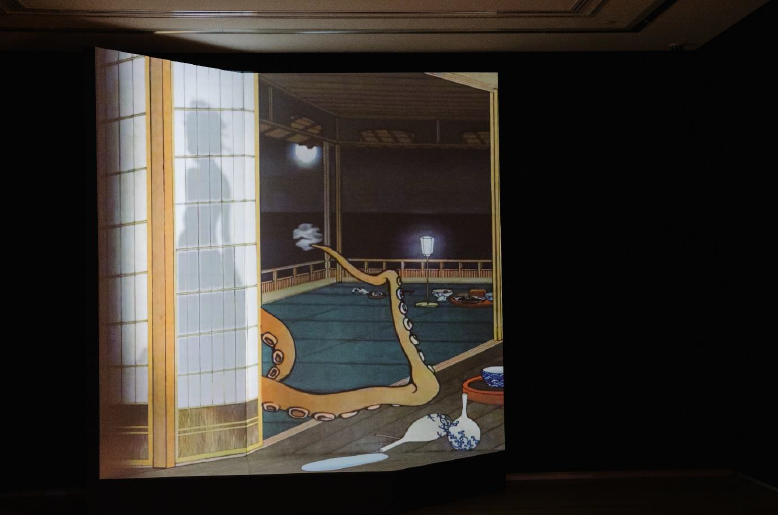
Tabaimo (born 1975) Japan
The Obscuring Moon 2016
single-channel video installation with audio and custom pedestal 10:36 min
courtesy of James Cohan, New York and Gallery Koyanagi, Japan
Latticed partitions from Utagawa Hiroshige’s Moon-viewing Point, 1857 ominously slide open and shut, releasing mysterious beasts into the moonlit environment. The Obscuring Moon, 2016 was inspired by the Japanese collections at the Seattle Art Museum. Utilising the ancient concept of utsushi (paying homage to past masters through emulation) Tabaimo transposes Hiroshige’s Moon-viewing Point into an animated video format. Thought to depict one of the many brothels or inns in the settlement of Shinagawa, Hiroshige’s print is unsettling in what it leaves absent or unsaid.
束芋 (1975年生)日本 隐月 2016 多媒体,人造舞台,片长10分36秒 纽约 James Cohan画廊及日本小柳画廊共同拥有 葛饰北斋观月处(1857)画作中描绘的格子纸门时开时合,将神秘的异兽引入了月光荧荧的世界。隐月 2016 从美国西雅图美术馆的日本藏品中得到灵感,加入了对日本“笔意”传统的致敬(“笔意”即用新的方式模拟往昔大家的意境),束芋用动画的方式将北斋的名作演绎了出来。在描绘某间位于江户品川的风月场或客栈的表象之下,隐藏着对于留白与未知的不安感。
An empty straw mat (tatami) dominates the centre of the composition, while the room’s occupants, a geisha on the right and a courtesan on the left, are half-hidden from view. The Obscuring Moon re-imagines and expands upon the mysterious ambiguity suggested in the etched lines of the woodblock print and hint at a darker, more sinister narrative. 位于占据画面中央的榻榻米左右两侧的风月女子和艺妓,犹抱琵琶半遮面,让人不见全貌。这幅由木刻版画衍生而来的作品在原作的神秘与隐晦之上,更添加了暗黑和妖异的氛围。
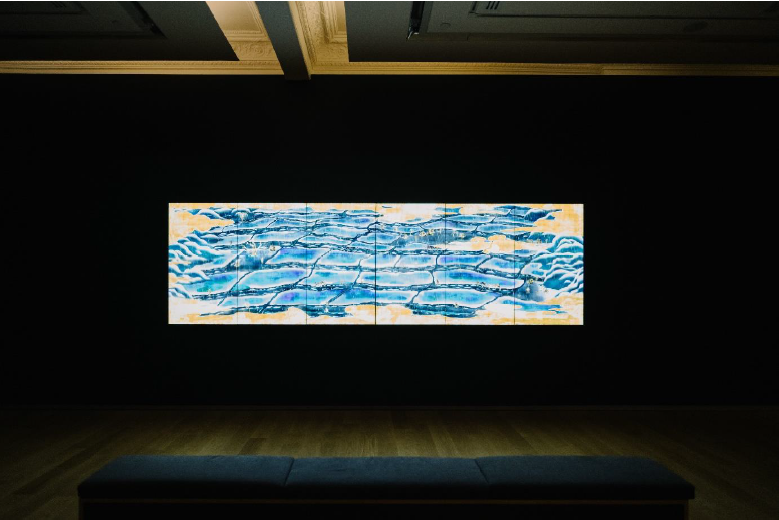
teamLab (formed 2001)
Four Seasons, a 1000 Years, Terraced Rice Fields – Tashibunosho 2016
six-channel digital video
courtesy teamLab and Martin Browne
Workers sow rice crops, people celebrate the harvest, a crane soars through the sky, and day turns to night. Focusing on Kyushu Island’s famed rice fields of Tashibunosho – unchanged for over 1200 years – this digital artwork explores the links between people and nature, seasonal change and the passing of time. teamLab (2001年组建) 四季、千年、梯田 – 田染庄 2016 六屏幕多媒体 teamLab和Martin Browne 藏品
农民正在撒种,群众正在欢庆丰收,晴空一鹤排云而上,转眼日光幻化为夜色。这件作品描绘了日本九州著名的梯田——田染庄1200年间未变之风情,将人与自然的和谐,季节的转换,以及时光的流逝娓娓道来。
Synchronised with real-life seasons, weather and time in Tashibunosho, the artwork immerses you within its landscape, connecting you to distant geographic environments through a shared moment in time. In constant evolution, each moment in this artwork is unique and rendered in shifting abstract colours and shapes, so that the layered history of Tashibunosho unfolds for you in an ever-changing present. 和现实中田染庄的季节、天气、时间相呼应,这幅作品将观者带入了山水之中,让万里之外的人也能够天涯共此时。作品中的色调与风情时时变换,让人在多变的现实体验中拨开田染庄的层层历史。
FAMILY LABELS
Come on a journey through Enchanted Worlds: Hokusai, Hiroshige and Art from Edo Period Japan.
Find out about the magic worlds and stories of animals, landscapes, myths and legends, and talk about your ideas together.
All these artworks were made during in Edo period of Japan – that’s between 400 and 150 years ago! They are painted on scrolls – long, narrow pieces of paper or fabric that could be rolled up and tied with a ribbon or unfolded to be hung on the wall.
Ask whoever is at home with you to help and to join in the fun!
让我们一起漫游浮世绘的世界:北斋、广重和日本江户艺术展吧。
在这里,我们可以探索奇妙幻境,聆听有关山水鸟兽的故事,了解神话和传说,然后分享自己的发现。
这里的所有作品都诞生于日本江户时代,距今有150年到400年的历史。它们被画在用纸或绢制成的长而窄的卷轴上。这些卷轴可以被卷起来,然后用丝线绑住,用来保存;也可以被打开,然后挂在墙上展示。
带上我们的家人,一起畅游在灵感的海洋里吧!
Katsushika Hokusai (1760–1849)
The Fox Hunter [Tsurigitsune]
from Immortals, Gods of Good Fortune and Kyōgen Actors 1839
set of 11 hanging scrolls (part of a set of 12), ink and colour on silk
Private collection
This scene is from a story about a fox who pretends to be a priest and tells a hunter why he thinks hunting is wrong. You are looking at the moment when the hunter bows to him. In Japan, bowing is a sign of respect.
Look at the picture. How does the artist show you that the priest is actually a fox? Have you heard foxes being described as cunning and clever? What is clever about the fox in this story?
Be inspired by this painting and write your own short story about an animal that changes into something else to fool someone. You can illustrate your story too if you like. Is there something you feel strongly about that the animal can talk about?
葛饰北斋 (1760-1849) 猎狐者 此作品是北斋1839年所作的《仙人、幸运之神、狂言演员》11幅立轴之一(原作有12幅) 立轴,绢本水墨设色 私人藏品 这幅作品描绘了一只装扮成僧侣的狐狸劝诫猎人放弃杀生的故事。作品捕捉了猎人向狐狸跪拜的刹那。在东亚文化中,跪拜是表达尊敬的最高礼仪。 仔细观察这幅作品:画家是如何透露出这个披着袈裟的僧侣其实是一只狐狸的?你知道狐狸以它们的精明狡黠而出名吗?在这则故事里,狐狸如何表现出它的精明? 以这则小故事为灵感,我们请你创作一篇动物用变身的方式教育人类的故事。如果你是一个小小艺术家的话,还可以给你的故事画一幅插图。你故事中的动物会和人类探讨什么样的话题呢?
Katsushika Hokusai (1760–1849)
Dragon and Clouds 1845
hanging scroll, ink and colour on silk
Private collection
In Japan the powerful dragon is a water god. He can make one season turn into another.
Look carefully. What do you notice about this painting? Describe how it looks and how it makes you feel to someone who hasn’t seen it before. Pick three words that describe how the dragon looks to you.
Draw this at home with any materials you can find. This is made with ink. If you don’t have ink you can water down some paint. Or even make your own ink with something in your kitchen – like marmite, coffee or tea.
Think about the mood of the painting – how it makes you feel. How can you make your painting seem happy and the dragon more friendly? What happens if you add in other colours?
葛饰北斋 (1760-1849)
云龙图 1845年
立轴,绢本水墨
私人藏品
在日本文化中,龙是拥有强大法力,可以转换季节的水神的化身。
仔细观察这幅画,你能找到哪些元素?试着向一个没有看过的人描述画中的景象,以及这幅画给你的感受。如果用三个词语来形容这条龙的模样,你会选择那三个词呢?
让我们以这幅画为范本,创作一幅自己的龙。虽然原作是用传统墨汁画成的,但如果你没有墨汁,可以用水稀释一些黑色颜料来创作。你甚至可以用厨房里的材料来制作自己的墨汁,像是marmite, 咖啡,或茶!
感受一下这幅作品透露出来的气势,它让你产生什么样的感觉?想一想如何能让你自己笔下的龙更加友善,如何让整幅画有着轻松愉快的感觉?如果你在黑色之外加入其他颜色,会对作品的气氛造成怎样的影响?
Keisai Eisen (1790–1848)
Japan
Gateway to Success circa 1825
hanging scroll, ink and colour on paper
This fish is a carp. In Japan carps are a sign of good luck and bravery. People give each other pictures of carp as good luck charms.
Which animal means good luck to you? Why?
Japanese scrolls tell stories through pictures, like comics. This carp is trying to reach the top of a huge waterfall to change into a dragon. Make your own comic strip about an animal changing into something else.
See how the artist shows the carp moving up the waterfall through the twisting of the tail and the curving lines of the water. How can you use line and shape to show movement in your comic?
溪斋英泉(1790-1848)
日本
鲤鱼跳龙门 约1825年
立轴,纸本水墨设色
画里描绘的是一条鲤鱼。在日本文化中,鲤鱼是幸运的象征。日本人常常将鲤鱼图作为幸运符赠送给他人。
你觉得哪种动物可以给你带来好运?为什么?
日本人喜欢通过图画来讲故事,就像他们擅长的漫画一样。这只鲤鱼想要逆流而上,到达瀑布的顶端,然后跳过“龙门”,变化为龙。让我们创作一个短篇漫画,来讲述动物变身的故事吧。
在这幅作品里,画家通过描绘鱼尾的扭动和弯曲的水纹来展示向上运动的态势。想一想在你自己的漫画里,如何用线条和图像来展示“移动”的概念?
Katsushika Hokusai (1760–1849)
Eagle in the Snow 1843
hanging scroll, ink and colour on paper
Tekisuiken Cultural Foundation
Look at this eagle and how carefully the artist Hokusai has drawn it. You can see every single feather on its wings.
How would you describe the look on the eagle’s face? Look in the mirror and try to copy the expression.
Hokusai loved drawing powerful birds of prey – like eagles and hawks. He even made a picture book about how to draw and colour them. Some people say that he may have thought that he was like an eagle.
Which bird represents you? Why did you pick that bird? Use a sharp pencil or coloured pencil to draw yourself as a bird. Try to show it in profile (from the side) like Hokusai has. What will you call your bird/human combination?
葛饰北斋 (1760-1849)
雪鹰图 1843年
立轴,纸本水墨设色
摘水轩纪念文化振兴财团藏
仔细看一看这只被北斋细腻刻画的老鹰,你可以看清它每只翅膀上的羽毛。
这只老鹰有着怎样的表情?在镜子里试着模仿一下它的表情。
北斋喜欢画凶猛的飞禽,像是鹰和隼。他甚至编著了一本如何画老鹰的教材。有一些人猜想,葛饰北斋是不是把自己想象成了一只雄鹰?
你想把自己比作一只什么样的飞禽?为什么?用一支铅笔(或彩铅)来创作一幅你和飞禽混合体的侧面像(像北斋画的鹰一样)。你会怎样命名这个角色呢?
Katsushika Hokusai (1760–1849)
Japan
Moon and Rabbit 1857
hanging scroll, ink and colour on paper
Private collection
This scroll shows a moon rabbit from Asian folklore. The idea came from markings on the moon that looked like this rabbit. Find a photo of the moon. Can you spot a shape that looks like this?
This rabbit is making mochi (rice cakes) for a festival about the autumn moon. This is painted from the artist’s imagination. Let your imagination run wild in a painting or drawing or collage. Create a picture of an animal wearing a costume and making some food. Which time of day or night will you show it in? If you have a pet, draw it from real life to start you off.
葛饰北斋(1760-1849)
日本
玉兔 1857年
立轴,纸本水墨设色
私人藏品
这幅作品绘制了东亚民间传说中的玉兔。古人看到月亮上的阴影,把它想象成了一只兔子。找一幅月亮的照片,看看你自己能不能发现有着兔子形状的阴影?
这只兔子正在为庆祝中秋节而制做麻糬(一种糯米制成的糕点)。画家完全根据自己的想象创作了这幅作品。发挥你的想象力来创作一幅穿着衣服的小动物烹制食物的图画或者拼贴画。你会在画中描绘白天还是夜晚的场景呢?如果你有宠物的话,就先让它们做你的模特吧!
Utagawa Hiroshige (1797–1858)
Japan
Great Waves of Sōshū Shichiriga-hama
circa 1847
This shows a beach area that is famous for its huge and scary waves. You can see that the biggest wave is frozen at the moment just before it crashes back into the sea. Follow the lines around the wave with your eyes or your finger. How would you describe these lines? Wiggly? Fast? Slow?
Imagine you are inside this scene. What would the sea sound like? How does it feel to be in the water? Is it cold or warm? What can you see between the waves? Think about where you would put yourself in the picture. Are you surfing on top of the wave? Are you under the water? Or safe on the beach looking at it?
二代目歌川广重 (1826-1869)
日本
相州七里滨之波涛
约1847年
这幅画描绘了以汹涌骇人的波涛而出名的海湾。画家把即将奔涌回大海的波涛定格了。用你的手指顺着波涛的线条划过,我们可以怎样形容这些线条?是曲折、迅猛、还是缓慢?
想象一下你身在这个场景中。大海会发出什么样的声音?海浪的触感是什么样的?是冰冷的还是温暖的?你在海浪中能看见什么其他的东西?你想把自己放在画中的什么位置上?是在浪尖冲浪?还是在海底潜水?或是在安全的海滩上观看潮起潮落?